Product Page Audit: Tools That Check What AI Actually Reads (2026)
Your product page has two readers — humans and machines. Here's how to audit the machine version: what AI crawlers receive, which tools show it, and the 8 facts every quotable product page needs.
November 6, 2026 · 5 min read · product-pages · audit · ai-readability · structured-data
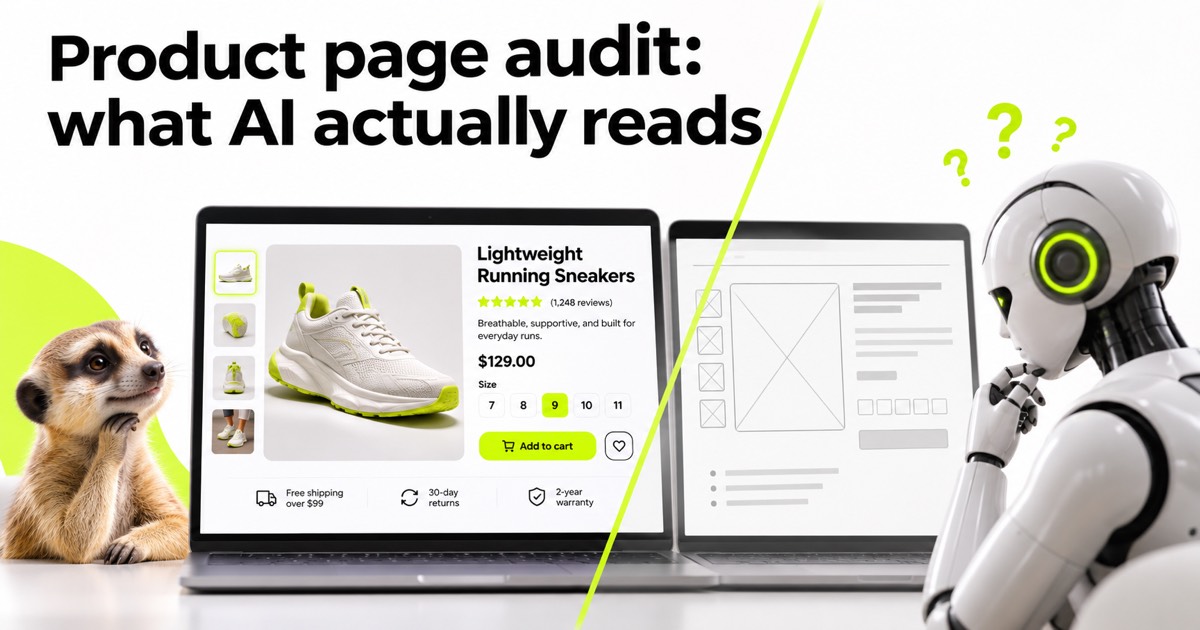
Short answer: a product page that converts humans can be nearly empty for machines. The audit that matters in 2026 answers one question: when an AI crawler fetches this URL — no JavaScript, no scrolling, no images — does it get the facts needed to recommend this product? Two free checks cover most of it: NIMSEO (full page, as bots fetch it) and Google's Rich Results Test (markup validity).
In this article
The two versions of your product page
The human version: photos, animations, reviews widget, sticky buy button — assembled by JavaScript in a browser.
The machine version: the raw HTML your server sends. Most AI search crawlers read only this. If your name, price and description are injected client-side, the machine version is a blank template — and no system recommends what it cannot read.
What a quotable product page contains
- Name as a proper heading in the HTML
- Price with explicit currency — in text and in Offer markup
- Availability (in stock / out of stock) in markup
- A description that answers first — what it is, who it's for, in the opening lines; not a wall of lifestyle prose
- Valid Product + Offer JSON-LD, server-rendered, one block only
- Identifiers — sku, and gtin/barcode when you have one
- Honest review markup — only real, collected customer reviews
- Correct
lang(anddirfor Arabic) so language detection doesn't fail
The tools that show the machine version
| Tool | What it reveals | Free? |
|---|---|---|
| NIMSEO | Fetches like AI bots: JS-free readability, markup validity, lang/dir, bot access — scored, with fixes | Yes |
| View source / disable JavaScript | The raw truth, manually | Yes |
| Google Rich Results Test | Markup validity (with Google-style rendering) | Yes |
| Schema.org validator | Markup syntax regardless of Google eligibility | Yes |
| Screaming Frog | Bulk version of the same checks across the catalog | 500 URLs |
The 5-minute manual method
Open your bestseller. Disable JavaScript (browser dev tools → settings). Reload. Can you see the product name, the price, the description? Now view source and search for application/ld+json — is there exactly one Product block, and does it carry price and availability? That's 80% of the audit. NIMSEO automates this and adds the parts you can't easily do by hand: bot user-agent fetches and robots.txt interpretation for AI crawlers. (Disclosure: our tool.)
Common failures we see
- The empty JS shell — server HTML contains a loading spinner and nothing else. The single most damaging issue; it caps everything else.
- Price in image or JavaScript only — unquotable.
- Two Product blocks (theme + app) with different prices — the AI can't tell which is true, and conflicting facts erode trust.
- Lifestyle-first descriptions — 300 words of mood, zero facts an AI can extract. Put the answer in the first two lines; the mood can follow.
- Review markup without reviews — self-rated 5 stars. Risky with Google, poison for AI trust.
FAQ
Google sees my page fine — why audit for AI separately?
Google renders JavaScript; most AI search crawlers don't. The same page can pass Google and fail ChatGPT's crawler. Two readers, two audits.
How long should a product description be?
Long enough to answer what it is, who it's for, and the key facts — in your own words. A useful 150-word description beats 600 words of template filler. The first lines matter most: AI systems extract answers from the top.
Do I need markup on every product, or just bestsellers?
Every product — markup comes from the template, so fixing it once fixes all. Prioritize bestsellers only for manual content rewrites.
Can AI quote my page if it has no structured data?
Sometimes, from well-structured text. But markup removes ambiguity about price and availability — the two facts that change hourly and embarrass an AI most when wrong. That's why it weighs heavily.
What about product images — do they matter for AI?
Alt text and image markup help; but no image compensates for missing text facts. Fix the text layer first.
Audit your product page now: free NIMSEO check — see your page the way AI crawlers do.